

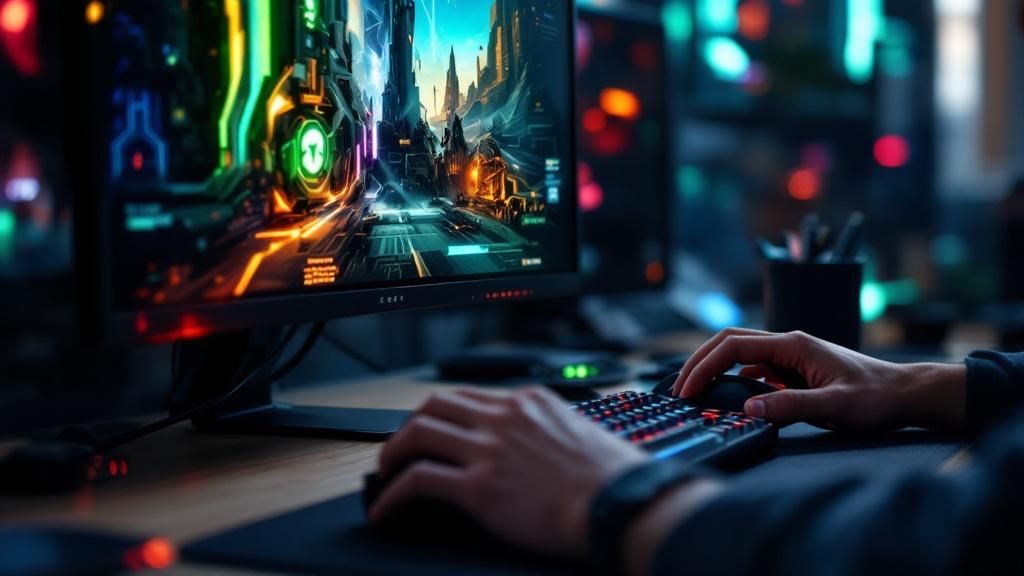
As the gaming industry develops with more challenging titles, your existing system may be failing to provide the level of performance you need. Whether you’re pursuing higher frame rates, sharper graphics, or seamless gameplay at highest settings, targeted hardware improvements can transform your gaming experience. This period, we’ll examine the essential components deserving investment—from high-performance graphics cards to lightning-fast storage solutions—ensuring your PC remains competitive and future-proofed for the major releases coming soon.
Graphics Card Improvements
The graphics card remains the foundation of any gaming computer, directly influencing your ability to enjoy contemporary games at high resolutions and frame rates. Whether you’re targeting 1440p performance or pushing towards 4K gaming, investing in a current-generation graphics processor is essential. Current-generation cards from NVIDIA and AMD deliver substantial improvements in ray tracing capabilities, DLSS technology, and general efficiency compared to their predecessors, making them worthy options for serious gamers seeking superior visual quality.
When choosing your upgrade, evaluate your target resolution and refresh rate carefully. A mid-range card suffices for 1440p at 144Hz, whilst 4K gaming requires premium hardware. Additionally, assess power consumption and cooling requirements, as newer cards often demand robust power supplies and adequate case ventilation. Waiting for the latest driver updates before purchasing guarantees you’ll benefit from optimisations and performance enhancements that manufacturers regularly release for supported hardware.
CPU and Motherboard Considerations
The processor remains the core component of any gaming computer, dictating overall capabilities and determining your system’s capacity to run modern games at competitive frame rates. Modern AAA games continually demand multiple processor cores, making it important to assess whether your current CPU meets contemporary standards. If you’re experiencing bottlenecking or finding it hard to run processor-intensive titles, moving to a newer generation processor—such as Intel’s latest Core series or AMD’s Ryzen offerings—can provide significant performance gains and extend lifespan for upcoming releases.
Selecting the right motherboard to match your processor upgrade is similarly essential for optimising gaming performance and system stability. Modern motherboards feature advanced capabilities including superior power delivery systems, enhanced cooling capabilities, and ability to handle faster RAM speeds, all of which enhance optimal gaming experiences. When considering a motherboard upgrade, select models that are compatible with your processor, feature enough expansion slots for later enhancements, and provide robust build quality that warrants the investment.
Budget constraints matter greatly when undertaking processor and motherboard updates, as these components involve considerable costs. Rather than pursuing the costliest alternatives, opt for mid-to-high range components that provide outstanding value for gaming needs, confirming your investment translates into measurable performance improvements and extended system viability for the gaming season to come.
Storage and Memory Options
Random Access Memory (RAM) and storage space are fundamental pillars of gaming performance that often are overlooked in favour of more eye-catching parts. Modern AAA titles increasingly demand 32GB of RAM to keep gameplay running smoothly at ultra settings, whilst faster DDR5 memory offers visible enhancements in frame stability and loading times. Putting money into fast RAM isn’t merely about quantity; the speed and latency specifications directly influence how swiftly your system processes game data, ultimately determining whether you encounter stuttering or buttery-smooth performance during intense gaming sessions.
Storage solutions have evolved considerably, with NVMe SSDs establishing themselves as the gold standard for serious gamers. These lightning-fast drives substantially cut down loading screens—a feature that distinguishes recreational from professional gaming experiences. Consider investing in a 2TB or larger NVMe SSD to accommodate modern games, which commonly surpass 100GB in size. Pairing rapid storage with adequate memory creates a complementary benefit, enabling your system to retrieve data instantly and sustain steady frame rates throughout extended gaming marathons, ensuring you’re never constrained by slower mechanical components.
Cooling Systems and Power Supply
When enhancing your gaming PC, disregarding cooling systems and power supplies is a common mistake that can result in significant expense. Powerful hardware produce considerable warmth, and insufficient thermal management causes thermal throttling, lower framerates, and reduced hardware longevity. Contemporary gaming systems require robust cooling solutions—whether air-cooled systems with enhanced heatsinks or integrated liquid cooling systems—to maintain optimal temperatures during long gaming marathons and resource-heavy operations.
Equally important is selecting a premium power supply unit (PSU) with adequate wattage and 80 Plus Gold standard or above. Graphics cards and processors require increasingly more power, and an inadequate PSU may lead to system failures, crashes, and physical harm to components. A PSU with modular cables simplifies cable management whilst enhancing airflow within your chassis. Together, these improvements ensure your gaming rig functions dependably, maintains peak performance, and safeguards your investment for many years of immersive gaming experiences.
